A Quiet Evening With Monks

This past weekend a group of Tibetan monks arrived in Grand Rapids. Two of them are from the Gyudmed Monaster in southern India, and two from a monastery in Mongolia, near Ulaan Baatar.

Early Sunday afternoon, at the Urban Institute for Contemporary Arts , they began the creation of a sand mandala. First they cleaned their work surface, a table perhaps six feet in diameter. Then, using a protractor, string, and folded paper, they drew the detail lines of the mandala. Fine lines of white sand were sprinkled over these lines; then, starting from the center and working to the outside, they drew gates and flowers and fields and religious symbols one grain of sand at a time. The final mandala was a little over four feet in diameter, and was built in three days.

And the monks did it all from memory. I asked one of the Gyudmed monks how he learned to do this extraordinary thing. He explained that the physical creation is only a part of a ceremony which, depending on the size and intricacy of the mandala, can last for many days. The monks first learn the meaning of the symbols, and all of the prayers which are recited as the sand is placed. They need to know the prayers which go before and after the work, and the reason behind these things. The mandala is laid out with exact geometric precision, and the colors are balanced and perfectly placed. The act of creating the mandala, a two-dimensional representation of the house of the gods, is itself a form of prayer, There are many different mandalas for different deities and concepts within the Buddhist religion.

Earlier this evening they destroyed it and threw the sand into the Grand River. Having been created, the mandala had served its purpose. The sand, and the prayers which had been focused upon it, was returned to the universe.

Teaching and Learning

As an addendum to the past few posts, a moment of strange synchronicity, I discovered that my high school wrestling coach works at the St. Julian winery branch in Parma, Michigan, just down the road from where I grew up.

I just returned from my last (for the moment) session teaching Tai Chi in Holland. Master Lee is due back in town tomorrow from his vacation in Vietnam, so I assume he will be resuming his teaching role. I enjoyed teaching out there. For the past four weeks I have had my own class; I have discovered what it is to be A Teacher. I am an assistant instructor in the classes here in Grand Rapids, but being assistant means there is someone above me who is watching as I teach. Out in Holland this past month I have been on my own. Any mistakes I have made will be painfully obvious in a week.

And it was great!

There is something to be said for taking a group of students and guiding them toward a particular ability, a particular understanding. A local college professor told me, when we were discussing the pros and cons of university professorship, that teaching can be addicting. It took a break in my instructor schedule, a group of new faces for the first time in five years, for me to understand what she meant. Teaching is as much an art as is sculpture or music or poetry. We take this great bundle of notions and instincts and reflexes, and tune it to a particular understanding. Then we step away and see if our instruction was sufficient to lead the student down the same path we explored those many years ago. If there are mis-steps or rough edges, we smooth them, redirect them, refine the recipients until they are ready to take on students of their own. No two students are alike. That is where the art comes in.

My Introspective Weekend

I just returned home from The Farm where I spend somewhere in the neighborhood of 36 hours eating, sleeping and taking pictures.

One of my goals was to take a good picture of a cow . You wouldn’t think this would be difficult; cows are not the stealthiest of creatures, nor the smartest. But they do have the middle-of-the-food-chain instinct of recognising that anything that looks directly at one of them is probably thinking of eating . So in order to coax the cows up to the fence I had to do the following: advance a few feet. Turn and face the other way. Look over my shoulder. Advance a few more feet. Turn and look the other way. Look over my shoulder. Turn around and stare off into the distance. Again, cows not being the stealthiest of critters I could hear them advancing, crunching and blowing. When the breathing was about arms’ length away I would do a kind of half-turn and shoot from the hip , so to speak. If I turned all the way around they would shy and turn their heads, and suddenly remember that they have not finished demolishing the wagonload of feed at the other end of the field.

So I now have a few good pictures of cows . Not the most imaginative poses, but just try explaining that to a cow . Their union is a bitch to deal with.

The big news of the past month is that, the day before Halloween, my step-father Don had what we of rural upbringing call ‘an accident’. He was cleaning out a jam in the cutting gear of a combine and caught his left hand on a belt. The belt yanked his hand through some pulleys and, to make a long (and fairly disturbing) story short, he now has eight fingers.

I like to think that thanks to violent video games I am immune to gruesome imagery. Then I remember a friend hosing down the inside of an old garage with Raid, which triggered a mass exodus of hundreds of spiders, all rappelling from the ceiling in a death spasm of silk. That gave me the heebie-jeebies for weeks. Don’s accident disturbs me when I wake up after having slept with my hands curled under my body, and one of them is asleep.

Continuing with my picture-taking odyssey I reacquainted myself with the farm where I spend so much of my youth, rising at 6 am or earlier to milk (sometimes) upward of 200 cows. I wandered around the old piles of junk and rows of discarded and obsolete equipment , watching my step and keeping an ear open for the inevitable farm dog or drunk hunter. Up around the bunker silo, up around the upright silos , into the barn , take a good hard look at the milking parlor and decide not to enter. I contemplate touching an electric fence for old-times sake, but I don’t know what that would do to my digital camera.

The high point of my day was when I discovered the decaying corpse of the Owatonna , a strange, distant relative of the combine. The Owatonna is to the combine as the mule is to the horse. This particular Owatonna had, when I was 12, chewed up my favorite cat, Mello Yello.

Don has phantom pain in his missing fingers, and sometimes he will jump as if he touched the fence. He is reading an article on how to deal with sensations in a part of you which is no longer attached. I once heard that the phantom sensation is usually of the last thing the limb or digit felt, so his accident is echoing in his nerves like a scream in a cathedral.

Farm equipment, which is of a class with construction equipment, comes plastered with a wide variety of warning labels, all of which are immediately covered over with mud and manure, never to be seen again. Some of it, like the warning on a power take-off (an external drive-shaft which plugs into whatever a tractor is pulling), are probably never seen outside of a farm. Others, such as those on silo blowers which warn you that kernels of corn are being shot a hundred feet into the air at near relativistic speeds and could give you a nasty bruise or even put out an eye, would be equally in place at a mining site.

Don is treating his accident with a ‘the worst is over’ stoicism coupled with a ‘could have been much, much worse’ awareness.

“Could have been worse” is always the case.
Fugaces Labuntur Anni

When I said a couple of days ago that I had to suffer through three hours of tai chi, that was pure hyperbole. Tai chi is usually the only thing which keeps me sane through the long hours of sleep and work.

Three chapters into Living Philosophy, and I am fairly impressed. The subject combined with the personal – sometimes approaching stream-of-consciousness – writing style sometimes reminds me of Finite and Infinite Games, but then Dr Rowe will focus in on a particular aspect of personal philosophy and make some quite interesting observations.

For instance, this is the first passage I underlined, from chapter 1: “The activity of philosophy liberates us…from assumptions and values, at least some of which we disagree with once we become conscious of them”.

To constantly ask ones self “why” can be exhausting. Each “why” leads to a because, which leads to another “why”, and so on, ad infinitum . Why am I angry? Because I am tired. Why Am I tired? Because I didn’t get enough sleep. Why? I stayed up late playing a PC game. Why? I was bored. Why? Distractions are easier than thinking. Why? And so forth.

I have not read a philosophy book in six or seven years. I changed my focus when I started writing, and critical thought made way for science fiction and poetry, the music of the language and the extremes of human imagination. Sharply focused deductive reasoning seemed less interesting and in some cases directly counter to my work. Now that I again have reason to read philosophy I find that I still enjoy it as much as I did in college, ten years ago.

Furor Scribendi

I have finished Off to the Side , and am wiser therefore.

Reading Jim Harrison has always affected me, usually hitting me with strong wanderlust, cabin fever, and a general dissatisfaction with many areas of my life. This time through I drove around a lot, explored those parts of Kent County of which I had always been aware, but never seen. I also tried purposefully to get lost, but what with the sun always directly south and the large number of large roads, this turned out to be impossible.

On Sunday I sat down with my dead-tree journal, an apple, and a bottle ($5.99) of Leelanau Cellars Autumn Red, a wine which has never disappointed. My idea was to enjoy the wine and the apple (which seemed an appropriate pairing) and, sip by sip, describe the experience of drinking.

And I discovered that this wine, which I have always quite liked, does not hold up all that well under close scrutiny. Granted that I am far from a connoisseur of wine, but this just tasted a little…off. Musty. Thick. If chilled in the refrigerator and drunk on a hot summer day it would more than serve, as it is quite dry, but slowly taken at room temperature with a tart apple it suffered.

The argument could be made that one gets what one pays for with wine, but last winter I picked up a case of, uh, some red wine for $20.00 which was excellent, light and dry and a steal at twice the price. Currently my favorite red is St. Julian Great Red ($5.99), which is difficult to beat at any price.

For some interesting writing about food -or using food as metaphor for sex, death, etc.- pick up Harrison’s book The Raw and the Cooked, a collection of his food columns from various magazines during the 1990s.

Next up is the Rowe book Living Philosophy , which should build my brain muscles up to where I can dive into Dostoyevsky after the Thanksgiving holiday.

Respice Finem

I am close to finishing the Jim Harrison memoir, so now I have little excuse to not dive into The Brothers Karamazov. I have the book set aside on my dining room table, next to a deck of Magic cards, an army surplus map case, a button, and Peter Gabriel’s latest album, Up . Between myself and The Brothers Karamazov, metaphorically speaking, are a philosophy book, David Egger’s new novel, and issues 1, 2, and 3 of McSweeney’s Quarterly Concern. More practically, before that stack is even cracked, I must suffer through six hours of sleep, eight to ten hours of work, and three hours of tai chi.

What kind of a sad world do we live in, where such worldly concerns are deemed more important than good literature?

Outside at 11:30 at night we have a light dusting of snow on all available surfaces, particularly the tree directly in front of my living room window which, in the bad light of the street lamp, in silhouette underneath the clouds, look like a negative of a stormscape. Or an aesthetically conscious mathematics experiment. Or just a snow-covered tree, stark against the sky.

Mare Liberum

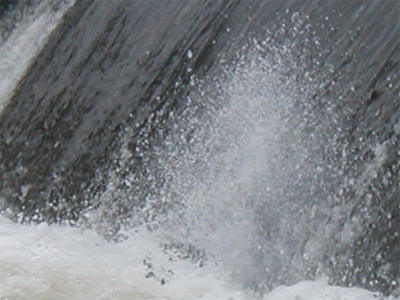
Every workday at lunch I head across the street to the east bank of the river. Here I relax and stare into the turbulence at the base of the Sixth Street Dam, the west side of which houses “the fish-ladder”, one of the more interesting constructs in the city. Scott is usually there with me. We find that the ebb and flow of the water, the infinite variations on the same scene, effectively wash away the visual trauma of hours spent staring at computer screens.

The daily scenes are variations on a theme: fishermen, fish, seagulls, ducks, some toxic-looking foam clinging to the rocks. Last winter we watched for half an hour as a huge ice floe drifted to the edge of the dam and crashed and splintered and thundered into the lower river. This past spring we watched as young ducks caught young fish and chewed them until they were soft enough to swallow. A gull caught a trout fly in mid-air and was thoroughly hooked. Scott gave a leather-back turtle an accidental hotfoot with a cigarette butt.

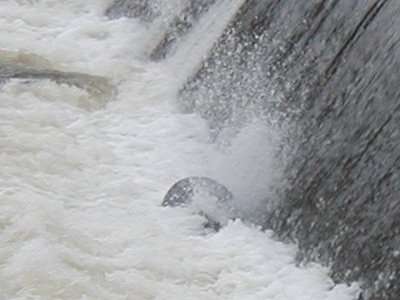
The undertow at the base of the dam traps buoyant objects against the falling water where they are gradually – time depending on material and density – worn away to nothing. A chunk of styrofoam which started out square will gradually become round. A basketball will become a smooth pink sphere. Large branches and trees will become hung up halfway over the dam, embedded firmly in the mud of the lower river. Smaller logs and branches gradually become smoother and softer until they appear, in a beautiful irony, to be manmade.

Today one of the smoothed, rounded logs found its way into the center of an old car tire and, acting as an axle, turned the tire toward the dam where it even now spins as if trying to climb the waterfall like a salmon; the rooster-tail sometimes reaches higher than the upper river. Even without taking into account the extreme odds against such a juxtaposition of events, the sight is extraordinary.

Omnia Mutantur, Nihil Interit

The new content management system is up and running. This is the first es.o post using the system. More later.

LATER
Okay. This is what the new CMA can do: create pages, alter pages, delete pages. 99% of what I do on this site is blogging, so that takes care of the overwhelming majority of what I need to do. And it looks cool.

Yesterday while shopping for supermarket sushi I ran into one of my old philosophy professors. Dr. Rowe was my advisor and mentor for the last two of my six years of higher (heh) education, and throughout the years since I have been an avid reader of his books.

He has a new one out, Living Philosophy , which is an introduction to a more humanistic philosophy than that usually taught and practiced in academia. His older work Rediscovering the West , a Buddhist-oriented examination of western traditions, made sense of many things which on which I had long since given up.

In the past three months I have had significant run-ins with two college professors; I have been dumped by a girl, I am working out and writing like a fiend, and I have watched several of my friends go through varying levels of significant personal trauma. It is as if my karma of a dozen years ago is coming around to remind me that though everything changes, nothing is truly lost.

Tempus Fugit

It is a terrible thing to realize that the journal you spent two months transcribing, eight years ago, is in a format so old it is not supported by current technology.

Today I drove away from the city, east to an area I discovered during this past week’s hellish Wednesday. With the anxiety out of the way I took time to enjoy the surroundings. As you approach Lowell on Thornapple River Road you have the edge of the Thornapple River flood plain on your right, and the river itself on your left with an old railroad track running parallel to the road. The sun was brilliant, the air clear and cold. I found a park a few miles south of Lowell and took pictures, mostly of the river. I didn’t stray too far for the deer hunters were making their presence known all up and down the opposite bank. And judging by the crippled duck I scared from a fallen tree, they were being none too discriminating with their targets. To a certain mindset, a large bald man in a black trench-coat looks a lot like a deer. That same mindset would probably think an ’89 Buick looks a lot like a deer.

Horresco Referens

Bookstore days:

customer: Do you have any books on bookshelves?
me: All of our books are on bookshelves.

A month and a half out from Christmas and we are well over halfway in to the obvious holiday marketing season. This is the third year since I graduated from college that I hold a job that is not particularly affected by the Christmas season; before programming, there were books and food.

With Cascading Style Sheet technology finally entering the mainstream the various popular/retail websites can update their look in an hour, where before a massive changeover of .gifs and FONT tags would take days – if the company in question could even be bothered to make the effort. Red, white and green are the same colors you will see if you are looking at a dead fish floating in algae.

This morning it occurred to me that with my last post I have increased the likelihood that people researching the photometric properties of Silly Putty will end up at es.o. Let us tip the scales some more: Silly Putty Silly Putty Silly Putty Silly Putty Silly Putty Silly Putty Silly Putty Silly Putty Silly Putty Silly Putty.

Don’t sue me. I’m funny.